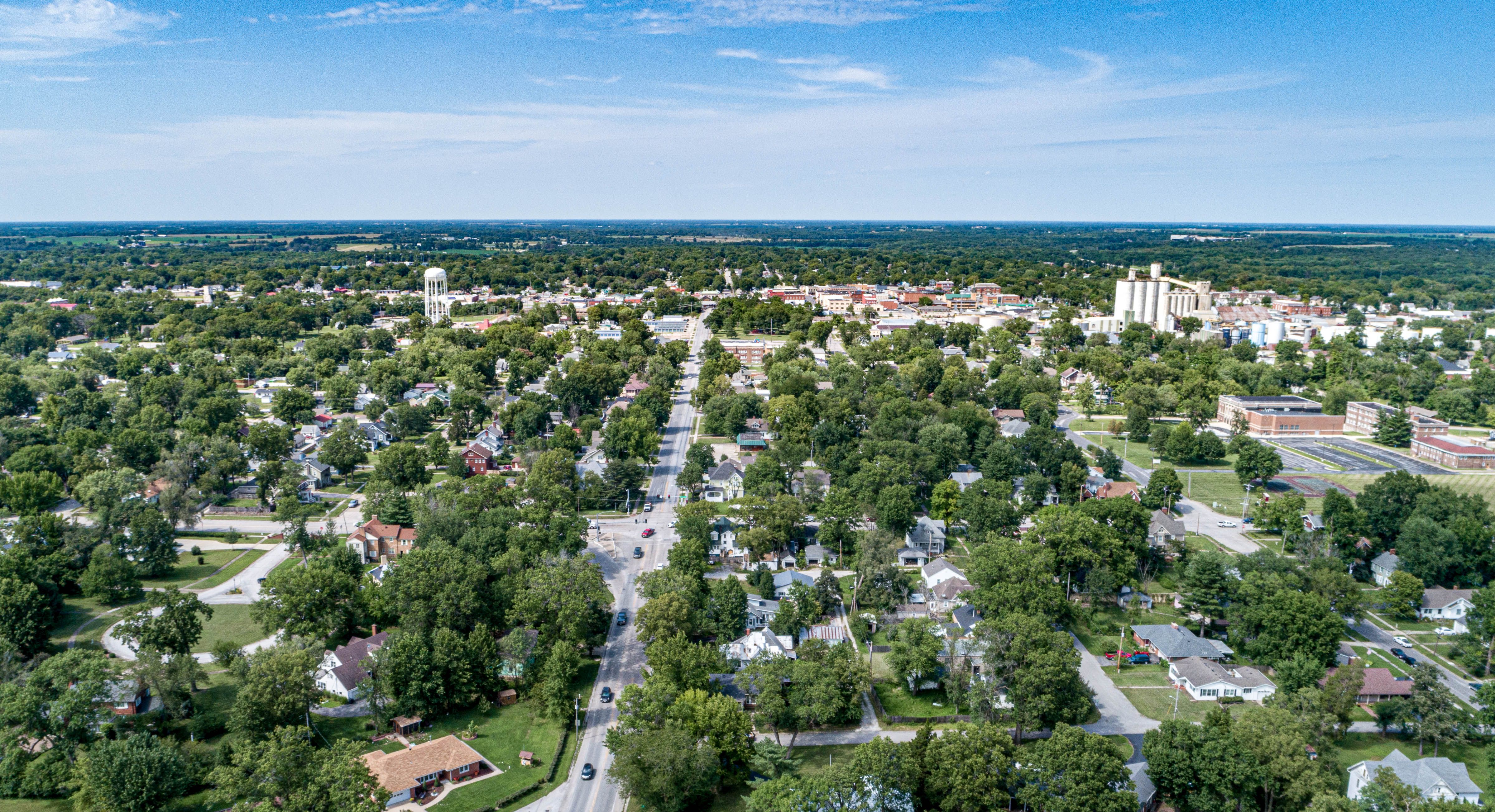

Google's data center campus in Columbia County could bring roughly 1,600 new jobs, 472 new local households and 307 new students, according to a third-party study released in September by the Columbia County Economic Development Authority. The 3,358-acre site off I-20 in Appling currently generates just $22k a year in taxes. Construction is underway, though full completion is still years away. Google has also agreed to pay the county $280 million over seven years to fund homestead property tax relief. If voters approve the mechanism this November, homeowners could receive up to an $18k credit per home. The study bases its job and household figures on research into similar facilities, so treat them as estimates rather than a project-specific employment forecast. For multifamily investors, the key question is how much of the projected job growth translates into local household formation. F5P will watch the Grovetown and Evans submarkets as the build ramps.
Between 2,800 and 3k construction workers are currently on site at the $15 billion Lighthouse campus in Port Washington, and the peak has not arrived. Vantage Data Centers' project plans call for roughly 3,500 workers in 2026, 5k in 2027 and 2k in 2028. The campus is being built for Oracle and OpenAI as part of the Stargate project. Once it opens, Vantage expects roughly one thousand permanent employees across the campus and its major customers. At the planned 2027 peak, construction crews would outnumber the permanent workforce about five to one. The spillover is already visible, with traffic and infrastructure upgrades being made as construction ramps up. Few small lakeshore communities are built to absorb a workforce surge this size. For operators, the near-term opportunity is short-lease and furnished product timed to the construction peak; the longer-term question is how much housing demand remains after the permanent workforce moves in.
San Francisco rents rose 25.6% year over year through August, faster than anywhere else in the country, according to Apartment List. In August alone, rents jumped 3.2%. Vacancy has fallen from a 5.1% peak in May 2024 to 2.4% in August 2026. Apartment List attributes the surge to strong AI-industry demand colliding with a supply-constrained housing market. Anthropic, OpenAI and other AI companies have expanded their presence in San Francisco, adding to demand in a market that had experienced elevated vacancy during the pandemic. Supply is not keeping up with demand, and the city's construction pipeline remains sluggish. San Francisco's Family Zoning Plan, adopted in December 2025 and effective in January 2026, allows substantially more housing capacity, particularly along major transit and commercial corridors and in parts of the western and northern city. But any major increase in completed housing supply will take time. For multifamily investors, San Francisco offers a sharp contrast to markets where apartment deliveries have outpaced demand. Underwrite rent-control exposure carefully: covered units can receive a general annual increase of 1.6% from March 1, 2026, through February 28, 2027, even as market rents rise sharply.
The 30-year fixed mortgage rate averaged 7.03% as of September 24. That is its first reading above 7% since January 2025 (Freddie Mac, NPR). In early March, the same rate sat at 6.00%, near its lowest level since 2022 (Freddie Mac). The reversal took just seven months. On a $400k loan, the jump adds about $271 to the monthly payment, or roughly $3,250 a year. The driver is the 10-year Treasury, which climbed sharply over the summer on inflation and federal debt concerns. For multifamily operators, higher rates slow one of the biggest sources of turnover: renters leaving to buy. Fewer move outs mean stronger renewals and lower leasing costs. BTR stands to benefit too. It offers the single family lifestyle without the mortgage, and that appeal grows with every rate increase. The risk cuts the other way on acquisitions. The same rates that keep renters in place also raise financing costs, squeezing the margin between cap rates and borrowing costs.
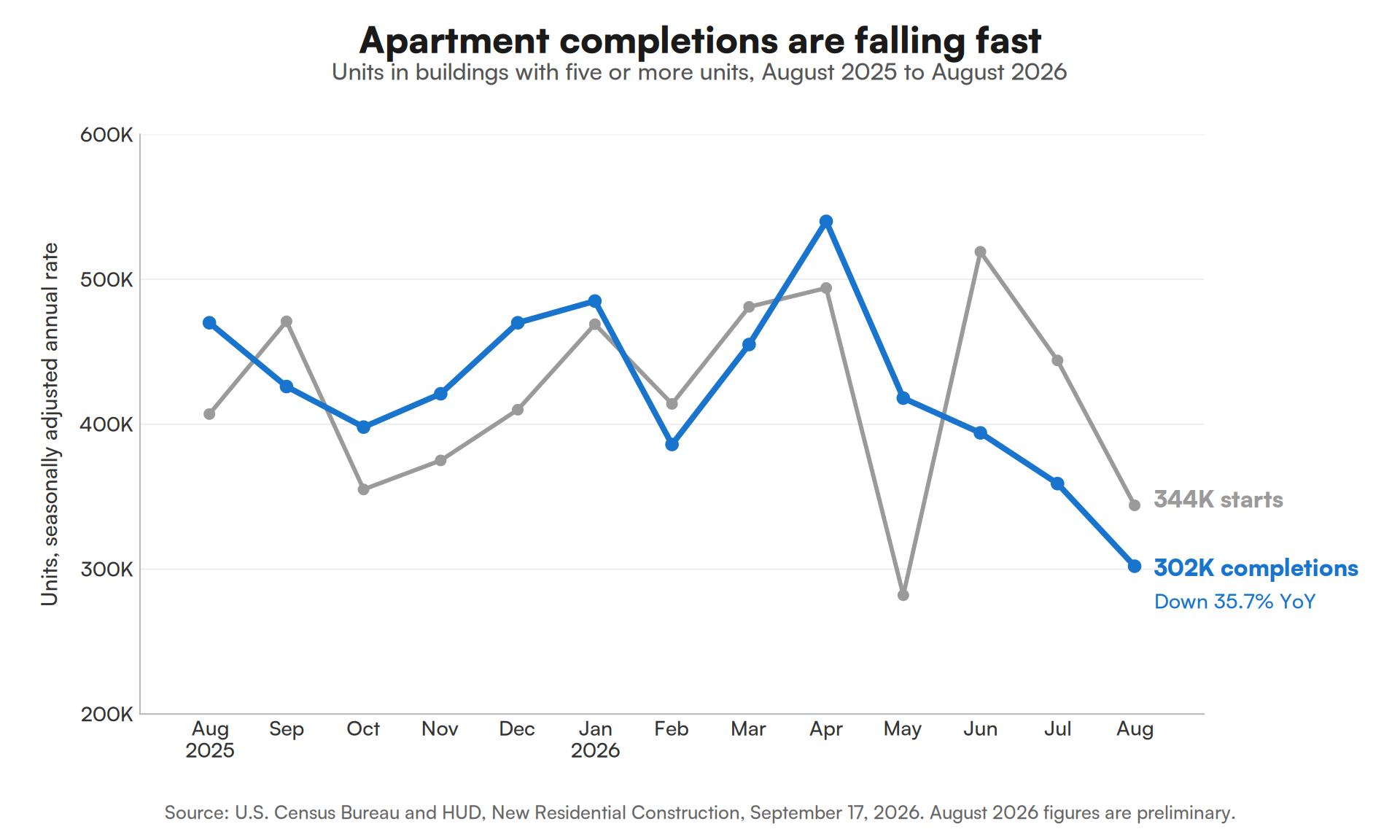
Construction started on apartment buildings with five or more units at an annual rate of just 344k in August, according to the Census Bureau (Census Bureau). Single-family starts moved the other way, rising 7.6% to 918k. Completions tell the rest of the story. Total housing completions fell 27.1% from a year earlier. Five-plus completions ran at a 302k annual rate. That is roughly half the pace of 2024, when more than 600k new apartments hit the market, the most in a single year since 1986 (Apartment List). Permits for five-plus buildings came in at 467k, well above starts. That gap may signal approved projects waiting on financing. With the 10-year Treasury near 5%, many may never break ground. Apartments typically take two to three years to build, so today's slowdown points to thin deliveries around 2028. For investors, oversupplied Sun Belt markets could tighten quickly once the pipeline empties.
Americans aged 25 to 44, the prime renting years, grew 5.9% nationally between 2020 and 2025. That adds about 5.1 million people, according to Census Bureau Vintage 2025 estimates (Census Bureau). That is good news for multifamily. The catch is where the growth landed. In the South, outlying metro counties grew their 25-to-44 population by 16.0%, nearly double the 8.9% pace in central metro counties. In the Northeast, central metro counties gained just 4.2%. Other age groups moved in different directions. The 45-to-64 population fell 3.2% nationally, while the 65-and-older group jumped 16.2%. The under-18 population shrank 2.4%. For operators, the implications split by product. Garden style and BTR communities on the metro fringe sit closest to the fastest growing renter pool. Urban core product in slower-growing regions relies on a thinner pipeline of young adults. The growing 65-plus group points to steady demand for age targeted rentals.