
Population growth, migration, and BTR expansion are driving new housing opportunities across key U.S. markets.
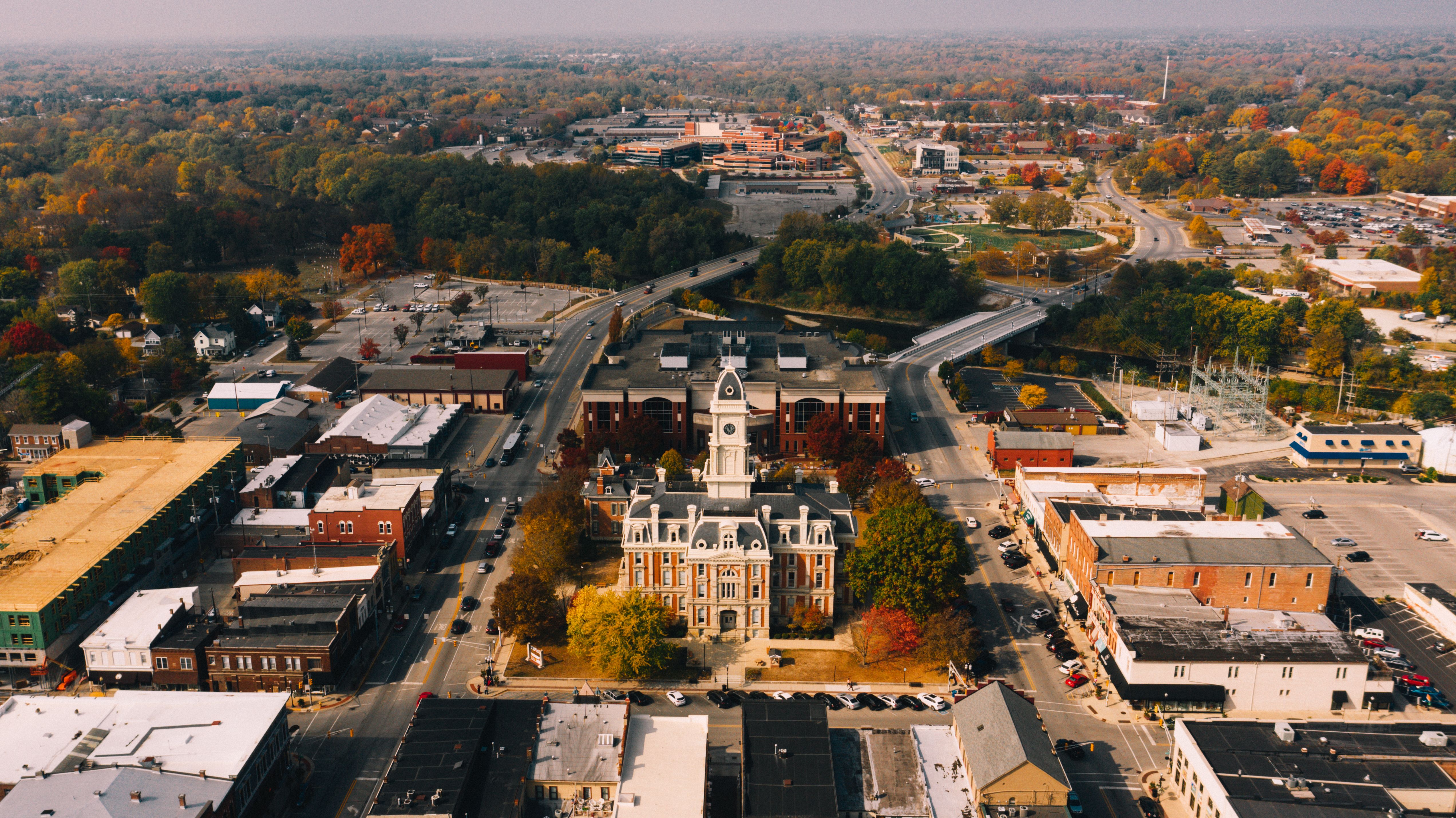
Tippecanoe County is one of Indiana's most consistently active real estate markets, anchored by Purdue University and a manufacturing and healthcare employment base that has kept the local economy insulated from the broader national slowdown. The Lafayette metro has grown by roughly 39k residents since 2000, with population gains of nearly two thousand per year. Analysts forecast 2% annual home value growth for the area through 2026, driven by institutional demand from Purdue's expanding research and medical footprint and a steady influx of young professionals who stay after graduation. Median home prices remain well below the national average, making the county one of the more accessible markets in the Midwest for first-time buyers. Multifamily permitting has outpaced single-family construction in recent years, reflecting the rental demand generated by the university. For a market without a single splashy headline, Tippecanoe has quietly delivered durable appreciation and low vacancy rates for over a decade.
Frederick County has long served as the pressure-release valve for buyers priced out of Montgomery County and the broader Washington metro, but it is increasingly standing on its own. Home prices rose 5.2% year-over-year in March 2026 to a median of $516k, outperforming the Maryland statewide average. The county's high-cost designation was reflected in its 2026 FHA conforming loan limit of $1.2m on par with the most expensive jurisdictions in the state. Demand is driven by a mix of federal government and defense workers, remote professionals, and young families drawn to the county's small-city character and school quality. Neighborhoods like Urbana, Middletown, and New Market consistently draw multiple offers on well-priced homes. Inventory has risen from its pandemic-era lows, giving buyers more options without tipping the market toward oversupply.
Snohomish County has emerged as one of the Pacific Northwest's most resilient housing markets, absorbing steady demand from buyers priced out of King County while maintaining its own employment base anchored by Boeing and regional health systems. The median home price sits at $736k as of April 2026, with most homes selling at asking price and more than half of all listings going pending within the first 30 days. Inventory remains tight at 2.8 months of supply despite a year-over-year increase in active listings. The structural driver of long-term demand is the Link light rail expansion into Lynnwood, which is unlocking transit-oriented development corridors in south county and drawing buyers who want commuter access without Seattle price tags. Everett continues to benefit from Boeing proximity and downtown redevelopment, with median prices in the low $600s offering meaningful value relative to the broader metro.
Benton County is home to one of the most unusual growth stories in the country. Anchored by Walmart's corporate headquarters in Bentonville, the county has attracted a dense ecosystem of supplier companies, logistics firms, and tech vendors, all of which have built local presences to stay close to the world's largest retailer. Northwest Arkansas has now crossed 605k residents and adds roughly 14k new residents per year, a pace that has kept housing demand ahead of supply. Average home prices in Benton County sit near $470k, with new construction near historic highs and accounting for nearly 40% of all transactions. Walmart's new Home Office campus, which opened in 2025, is accelerating relocations of corporate employees and extending the demand profile beyond entry-level housing. The region's outdoor amenities, including its designation as the mountain biking capital of the United States and the Crystal Bridges Museum, have made Bentonville a lifestyle destination that competes with far larger cities for talent.
Utah County is the engine of the Silicon Slopes corridor, stretching from Lehi through Provo and Orem with a concentration of tech employers including Microsoft, Adobe, Oracle, and a dense field of fast-growing startups. The county benefits from the youngest median age in the United States and one of the highest birth rates, creating durable structural demand that most markets cannot replicate. Tech-corridor areas along the Wasatch Front are projected to see 6–8% home price appreciation in 2026, outpacing statewide forecasts of 3-4%. Development is accelerating at the edges: Vineyard is converting former industrial land into lakeside neighborhoods with thousands of planned units, and Eagle Mountain has permitted more than 8k homes alongside incoming data center infrastructure. The county's long-term housing shortage remains the defining market condition, with population growth consistently outrunning new supply and providing a durable price floor even as inventory increases modestly from its pandemic-era lows.
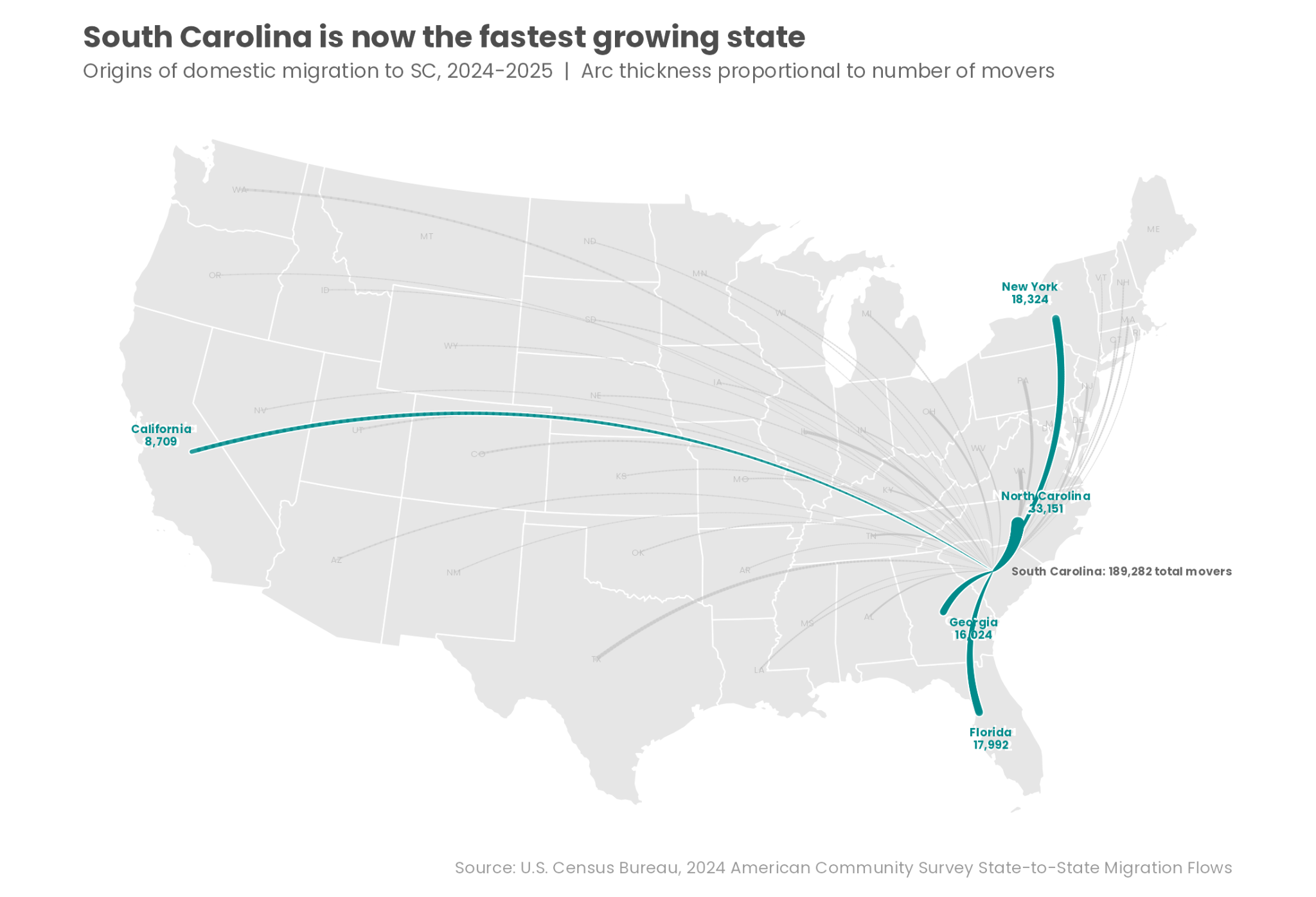
South Carolina gained 80k new residents between 2024 and 2025, making it the fastest-growing state based on percentage change. The inflows were led by nearby North Carolina and Georgia, alongside higher-cost states like New York and Florida. This comes as national population growth slowed to 0.5% in the same period.
The Palmetto State is attracting multiple crowds. Coastal counties are attracting retirees and second-home buyers drawn to lower housing costs and lifestyle amenities. Meanwhile, equity-rich households from the Northeast and Florida are relocating for affordability. In the Upstate, working-age migration is tied to advanced manufacturing and logistics growth, anchored in part by infrastructure like the Port of Charleston.
For real estate, the signal is clear: demand will skew toward retirees, remote-capable professionals, and logistics/manufacturing workers. Markets that deliver attainable housing, lifestyle amenities, and proximity to job corridors are best positioned to capture the next wave of in-migration.

Meta broke ground in February on a $10 billion, 1,500 acre data center campus in Lebanon, one of its largest infrastructure investments to date and a major anchor project inside Indiana's LEAP Innovation and Research District. The roughly 4 million square foot complex will include 13 buildings, including 10 dedicated data center structures, and deliver 1 gigawatt of computing capacity once fully operational. Construction is expected to support more than 4000 workers at peak, with roughly 300 permanent operational jobs once running. It is Meta's second Indiana project, following an $800 million Jeffersonville facility, and adds another major investment to the rapidly expanding LEAP district. For a county of roughly 70k people, that construction workforce could pressure local rental supply well before the permanent jobs arrive.